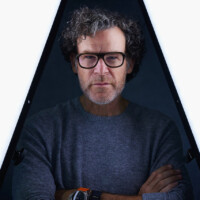
Why Even the Most Successful People Hate Getting Their Picture Taken
I’ve been photographing people up close for almost twenty years now, and here’s the thing nobody tells you going in. It doesn’t get less predictable. I’ve had CEOs who run million-dollar meetings without blinking. I’ve had creators with followings the size of a small city. I’ve had a literal Miss Universe standing in my studio. And I get the same reaction back, over and over, “I can’t stand my face.” Mid-edit, looking at her own photo, that’s what she said to her husband. Miss Universe.
That one stuck with me. Because if she doesn’t get a pass on this, nobody does. Whatever this thing is, it’s not about how you actually look.
I didn’t have a name for it until I found the right person to ask
For years I just filed this under “people are weird about cameras” and moved on. Then I met Anna Rowley. She’s a psychologist, PhD out of London University, and she’s spent her career embedded inside places like Microsoft, Yahoo, LinkedIn, and GoDaddy, basically living inside corporate psychology at a level most photographers never get near. We met on a Microsoft shoot, started comparing notes, her side of the lens and mine, and eventually we took it to a TEDx stage in Cambridge and gave the thing an actual name, the self-acceptance gap.
Here’s the idea. Everyone’s got some distance between how they see themselves and how the world actually sees them. For some people it’s small. For some people it is massive, and it has nothing to do with what’s actually true. Anna told me something on that stage that I think about constantly. She’d spent her whole career helping other people manage this exact kind of fear, and she still avoided being photographed by me for as long as she possibly could. Her words, not mine. She’d have developed “a mysterious skin condition” if she thought it would get her out of it.
If a psychologist who studies this for a living still can’t dodge it, that tells you something. The camera doesn’t create that gap. It just shines a light on one that was already there.
Why you don’t recognize your own photo
I’m not a scientist, but I went looking for why this happens, and it turns out there’s real research on it. There’s a study from 1977, two psychologists, Mita and Dermer, that found people consistently prefer their mirror image over their actual photographed image, while their friends prefer the real one every single time. Makes sense once you hear it. You’ve looked at your face in the mirror, reversed, thousands more times than you’ve ever seen how you actually look to everyone else. So a camera shows you a face you’re not practiced at recognizing as your own. That’s not the photo lying. That’s just math on how many times you’ve seen which version.
Anna also connects this to imposter syndrome, that fear-of-being-found-out thing that’s been studied since the late seventies, usually in high achievers who privately think they don’t deserve what they’ve built. She thinks camera dread is the exact same fear, just showing up physically instead of professionally. And honestly, that tracks with what I see on set. It’s not the people with the least going for them who freeze up in front of me. A lot of the time it’s the ones with the most.
The four things people do in front of my camera
Between what I’ve watched happen thousands of times and what Anna’s studied for a living, we landed on four patterns:
- Own it, 7%
Grounded. Visible. Comfortable being seen, full stop. - Pose, 15%
Turn into something other than themselves. - Diminish, 60%
Physically try to take up less space. - Avoid, 18%
Cancel. Reschedule. Find any reason not to be there.
If that math surprises you, sit with it for a second. Everybody else, meaning almost everybody, needs something from the person on the other side of the camera to get there.
Posing is where actors tend to land, since performing on cue is literally the job, and that changes the work enough that actor headshots run differently from everything else I shoot.
Avoiding is the one I ended up naming, because I kept seeing it, picture avoidance syndrome. PAS. I’ve had friends hear that phrase and diagnose themselves on the spot. If your headshot has been sitting on your to-do list for three years, or the business headshot on your LinkedIn is from a job you don’t even have anymore, I promise you that’s not a scheduling problem. That’s PAS.
And here’s a detail that took me a while to actually understand. Nobody’s scared of a selfie. You take your own picture, you’re still in control, nobody’s judging you back through the lens. Hand somebody else the camera and that control is gone. That loss of control is the actual fear. It was never really about the photo.
Why I care about any of this before I even pick up the camera
Once you understand the gap, it changes what I’m actually trying to do on a shoot. I’m not there to hand somebody a technically clean photo of a face they already don’t like. I’m there to close that gap, even if it’s just for the length of the session, so what I capture is a real reaction instead of a held pose over an argument you’re having with your own mirror.
And believe me, I can suss out which one of those four people you are within minutes of having you in front of my camera. So I adjust how I run the session, my own energy, my pacing, how much room I give you to warm up, to actually meet you where you are instead of running the same session on everybody.
That’s the whole reason I direct a session the way I do. I’m chasing a genuine, unguarded moment, not a performed one. I want the shot to read as confident, approachable, and authentic, because that’s what happens when the gap closes even a little. Every single face I’ve ever photographed has its own version of that. The problem was never that it wasn’t there. The problem is the person standing there usually can’t see it in themselves, and if you point a camera at the wrong moment, all you do is confirm the thing they were already afraid of.
If your photo has been sitting on your list longer than you’d like to admit, that hesitation has a name now, and it was never really about your face. That’s exactly what I built my studio to fix, whether that’s one frame or a personal branding session that covers your site, your press page, and everywhere else.
You don’t have to be a natural in front of a camera
Almost nobody is. Getting you there is my job, not yours. Show up, and I’ll handle the rest.