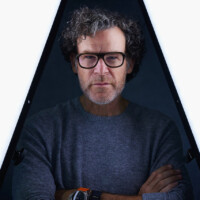
Actor Headshots: A Guide to What Casting Directors Want
Every part of what I do now started with New York actor headshots.
Not corporate. Not personal branding. Actors, in this city, who needed a picture that could get them the audition before anyone ever met them in person. I opened the studio in 2002 and built the whole thing on Backstage advertising. Everything else, the corporate work, the tutorials, the network of photographers I’ve trained, all of it came after and grew out of what I learned shooting actors first.
A casting director sees your headshot before they ever see you. They’re working through hundreds of submissions, not studying your face, just scanning for a reason to stop, and your picture is the only part of the package that gets seen whether or not anyone reads the rest.
I still shoot actors. It’s the work I know best, and this is the long version of everything I’d tell you if you sat down across from me and asked what actually goes into one of these sessions.
Why Backstage readers voted me New York’s best actor headshot photographer
I built this business on actors, and the actors voted for it. Backstage readers named me New York’s best headshot photographer, for several years and it’s the credential that means more to me than any of the others, because Backstage readers are the people I actually shoot, not a panel of judges or an industry award committee. The rest of it is real too: Canon Explorer of Light, features in the New York Times, the Wall Street Journal, Good Morning America, Nightline, a TEDx stage, teaching sessions at Google, Apple, and Microsoft. But an ABC casting director named Marcy Phillips gave me the line I actually measure myself against: I make actors look like they’ve already made it. Like celebrities.
Two sessions stick with me more than any of that. I had an actor shut down completely once. I stopped, offered his deposit back, and told him he should probably go home. Something in him broke open, and he came back at it. Years later I spotted him in a supporting role on a show a lot of people have seen. And there’s the one I think about most: an actor who tried to book me three years before she finally could afford it. She came in on a tax refund, saw the shot, and started crying, because she’d spent three years auditioning with headshots that weren’t working for her.
None of that is the reason to book me, it just answers whether I know what I’m doing. What actually matters is what makes an actor headshot different from every other kind, and what I do about it.
What is a headshot in acting?
An actor headshot is a chest-up photograph of your face, shot for one purpose, to get you the audition. A casting director works through hundreds of submissions and sees it long before they see you, so its whole job is to make someone stop and want to meet you. It is not a portrait and it is not a flattering picture of you on your best day. It is the picture that has to look like whoever walks through the door.
Why acting headshots are harder to shoot than people assume
Everybody needs a headshot now. Google yourself and see what comes up. But for an actor it’s a different thing entirely, because there’s a job riding on it, and I have never met an actor who didn’t feel that walking in the door.
Being a good actor doesn’t make you good in front of a still camera, and I’d rather say that plainly than pretend otherwise. Acting is reactive. You have a script, a scene, somebody across from you to work off of. Take all three away, point a lens at your face, and there’s nothing running. I’ve watched trained, working actors go completely blank the second the camera came up. That’s not a talent problem. There’s no scene.
So I hand you one. I tell actors straight out that they’re going to play an actor. That turns the job from a self-portrait, which nobody on earth is actually good at, into a part, which is the thing you already know how to do. It’s the whole difference between ordinary headshots and actor headshots: one just needs to look like you, the other has to get you cast.
The range every actor headshot session has to cover
You’re submitting for different types of roles and different types of jobs, and the same face doesn’t work for all of them. So the session isn’t built around one picture you like. It’s built to produce a range, and I direct you through each look deliberately, one at a time, instead of shooting two hundred frames of the same expression and hoping variety turns up somewhere in the edit.


That means covering real ground. Bad guy, boy next door, cop, DA, drug lord. For women, the sweet girl-next-door read all the way through to the hardest edge you can carry. For men, the nice guy through to somebody you’d cross the street to avoid. I push apparent age in both directions too, because the call you actually get is rarely the one you had in mind.
If you come in with scruff, we shoot it both ways before it comes off. Two more looks for the price of walking in unshaven.
Range is what gets you seen, and range is what separates a real actor headshots session from a quick photo op.
Commercial headshots vs. theatrical headshots, and why you need both
People ask me whether commercial and theatrical headshots need a different session. They don’t. It’s the same session either way, and I shoot whatever range of looks a given actor needs within it, commercial, theatrical, and everything in between, as called for.
But the two ends of that range are pictures that read completely differently, and it’s worth being specific about what separates them.
A commercial headshot is the warm one. Bright, open, approachable, the face a brand wants selling their product. Friendly and trustworthy on purpose, because the job is to make a stranger comfortable in about a second. It books advertising, product work, anything where the casting note is relatable.
A theatrical headshot goes the other way. Grounded, with something underneath. Film, TV drama, and stage want emotional depth and a hint of what you can carry, not a pleasant expression.
Most actors need both. Most agents expect both. Whether you call the stage-facing side theatrical headshots or theatre headshots depends on which side of the Atlantic you trained on, the picture is the same. That’s why the range work in the section above isn’t a nice-to-have, it’s the actual point of the session: you’re not choosing one lane, you’re covering the ground your career is going to ask you to cover, and finding out later that you’re missing the theatrical side, or the commercial side, means coming back for a second session instead of walking out with everything the first time.
How I prepare you before we shoot anything
I ask you to overpack. Bring more than you think you’ll need, weighted toward tops since a headshot is shot from the chest up. A range of cuts, colors, and necklines does more for the variety of your final looks than almost anything else you control. If you’re coming in for commercial work, that’s several shirt and jacket combinations. If you’re an actor building range across castings, layer and ignore the season entirely, since you’re not dressing for the weather, you’re building options.
Bring every pair of glasses you own if you wear them. Keep jewelry small unless a piece is actually part of how you present yourself. And if your closet is missing something, buy it, we keep the tags on so you can return it after.
The wardrobe and grooming specifics that apply to every session, not just actors, get their own full treatment in what to wear for a headshot.


How the session actually runs
I direct you through the whole thing. Where the chin goes, what the shoulders do, what the eyes are doing, and the expression on top of all of it. We work through the looks one at a time rather than shooting blind and sorting it out later.
I have never once told a client to smile. A smile that gets asked for on command looks asked for, and casting directors spot it faster than anybody. So I do the opposite. I get you laughing at something and shoot the back side of it, the moment right after, because that’s when the face has actually relaxed and whatever expression is left is real.
You see the images as we shoot, on a tethered screen, not weeks later in a gallery link. We narrow the set together as we go, so what you leave with is what actually survived the session rather than a folder of everything to sort through on your own. It’s the same system I walk through start to finish in what a session with me is actually like.
What separates a good actor headshot from a bad one
I judge every finished image on one axis, which I call lookability: whether it can secure attention from whoever’s looking at it, cold, in the first second, with no context. Good actor headshots clear that bar instantly. Bad ones give a casting director a reason to keep scrolling, and it’s almost never a mystery why.
A bad actor headshot is usually bad for a specific, fixable reason, not a mysterious one, and I get into why most headshots out there are not good separately.
How much retouching an actor headshot should have
My rule on retouching hasn’t moved in over a decade: if I can look at a picture and think, that’s retouched, it’s too much. I don’t take away anything real, because if I can see it, the casting director sees it too, and the picture stops matching the person who shows up.
The standard doesn’t change for actor headshots specifically, but the stakes do. A casting director isn’t just evaluating a photo, they’re deciding whether to bring you in based on it, and if the person who walks through that door doesn’t match the picture, that’s a broken promise before you’ve said a word. I don’t allow a retoucher to alter my images past my own approval, and the standard is simple: everything should still look real. What I’m actually doing is smaller than people expect, color correction, a stray hair, the kind of thing a good night’s sleep would have fixed anyway. You should look like you, on your best day, not like a different, smoother person wearing your face.
What headshots for actors cost
Actor headshots start at $1,500 with me, or $500 with Britney Young, the associate photographer who shoots when I’m traveling. Both work the same way: a flat session fee, then you pay per image for the ones you choose to keep, with unlimited licensing for personal use on whatever you purchase. Images go to the retoucher right after the session, and you’ll have your finished files one week after the shoot date.
Sizing, cropping, and what casting platforms actually want
Once you have images you’re happy with, the technical side is simple, and most of it is decided by the platform you’re submitting to rather than by taste. Actors Access and Casting Networks, the two platforms nearly every actor submits through, both want a JPEG file in sRGB color, not Adobe RGB or CMYK, since those won’t display correctly online. Actors Access takes files up to 5MB at a minimum of 600 by 750 pixels. Casting Networks wants the same minimum but recommends 1200 by 1500. The traditional 8×10 vertical crop is still the safe default across both, even though some platforms will technically accept a square crop. Your resume attaches as its own separate document either way, it’s never combined into the image file itself.
None of that is complicated, but it’s exactly the kind of detail that’s easy to get wrong once, and mildly annoying to have to fix after the fact.
How often you actually need new headshots
There’s no fixed interval on this, and I’d rather give you the real rule than a made-up number. Replace a headshot when it stops looking like you. Aged, changed something about your appearance, grown into a different person than the one in the photo. Recency and likeness are part of what makes a headshot do its job in the first place.
For actors specifically, the stakes matter more than they do for almost anyone else I shoot. Casting decisions ride on the assumption that you look like your submission. The moment that stops being true, the headshot has failed at its actual job, whether it’s six months old or six years old. A picture that doesn’t match who shows up fails the same way an over-retouched one does, it just takes longer to notice.
Booking an actor headshot photographer in New York
The studio is in New York, and the session runs the same way for anyone whose face is the product: singers, dancers, musicians, comedians, voice actors, and Broadway performers all stand in front of the same lens, get the same direction, and go through the same range-building process actors do.
If you’re weighing photographers, the honest test is simple. Look at whether the range in their portfolio is real range, different castings, different energy, not the same expression shot from a few different angles and called variety. That’s the actual job, and it’s the thing worth paying for.
A casting director sees your headshot before they ever see you. Make sure it’s the reason they call you in. See what an actor headshot session looks like, or book directly.